Read Article
When it comes to pursuing a career in law, selecting the right entrance exam is crucial. In India, three major law entrance exams – CLAT, AILET, and LSAT India – offer pathways to top law schools.
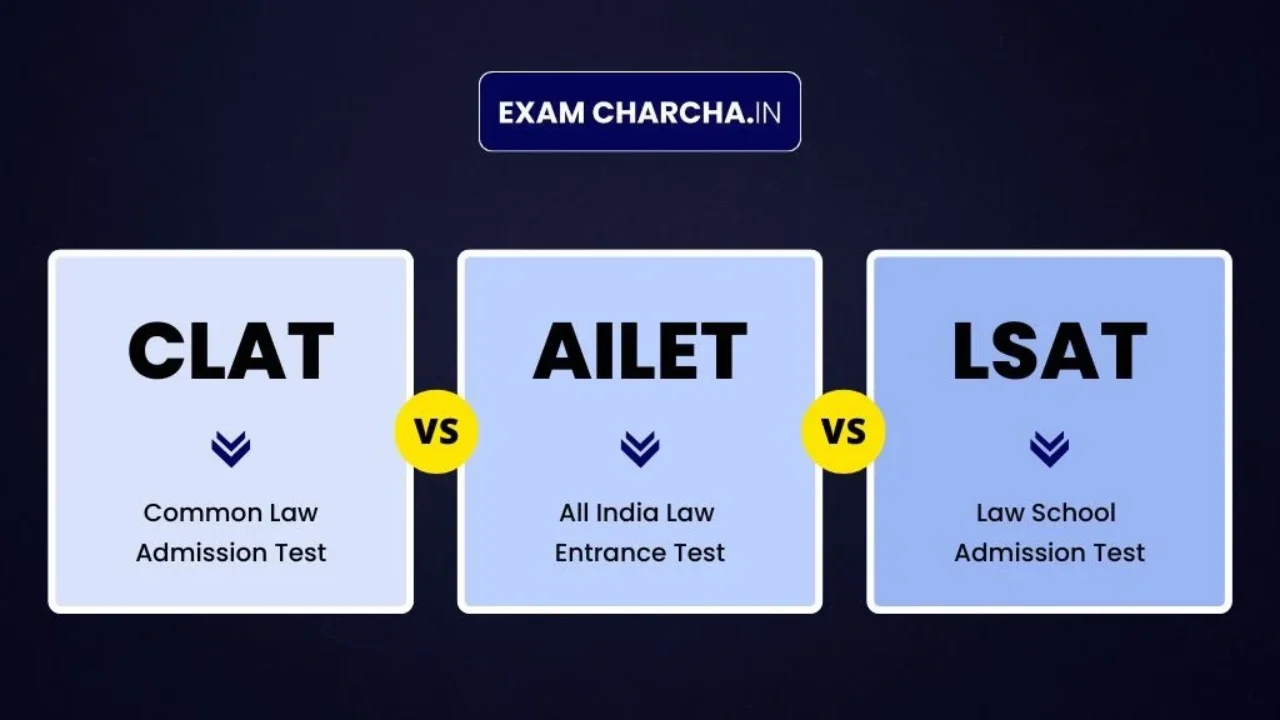
Each exam has its own structure, syllabus, and admission process, making it important for students to understand the key differences. We will provide you with a clear comparison of these exams, helping you decide which one aligns best with your academic goals and future aspirations.
Whether you aim for NLUs or other prestigious law schools, understanding these exams will guide you in making an informed choice.
The Common Law Admission Test (CLAT) is a national-level entrance exam conducted for admissions to undergraduate (UG) and postgraduate (PG) law programs at National Law Universities (NLUs) across India.
Managed by the Consortium of NLUs, CLAT is a highly competitive test that evaluates candidates on subjects like English, General Knowledge & Current Affairs, Legal Reasoning, Logical Reasoning, and Quantitative Techniques.
This exam is held annually, and the CLAT exam pattern includes multiple-choice questions with negative marking.
Next CLAT Exams
This section evaluates your reading comprehension, vocabulary, and grammar. Strong communication and comprehension skills are essential for success in law school, and CLAT ensures you possess the necessary foundation.
This section introduces you to a basic understanding and applications of the fundamental principles and concepts of law. It assesses your ability to analyze legal situations, identify principles, and apply basic legal reasoning.
This section tests your logical and critical thinking skills. You will encounter problems that require you to understand, analyze, and evaluate arguments by identifying premises, conclusions, and their logical dependencies and implications. These skills are crucial for success in law school, where you will be expected to analyze complex legal arguments and case studies.
Staying informed about current events and legal developments is a must for any aspiring lawyer. The CLAT Current Affairs section tests your knowledge of recent national and international issues, legal news, and judgments.
Don’t worry-this section focuses on basic mathematical skills like data interpretation, percentages, and ratios, which are an important part of the CLAT Maths syllabus and are often used in legal analysis and argumentation.
CLAT 2027 All-in-One Guide Table:
The All India Law Entrance Test (AILET) is a national-level entrance exam conducted exclusively by the National Law University (NLU), Delhi, for admission to its undergraduate (UG), postgraduate (PG), and Ph.D. law programs.
Unlike CLAT, AILET is specific to NLU Delhi and is the only way to gain admission to the law courses at this university. AILET is held annually, and it follows a multiple-choice format with negative marking.
The AILET syllabus closely resembles CLAT and LSAT-India, focusing on the following areas:
The English language section tests your reading comprehension, vocabulary, and grammar.
The logical reasoning section evaluates your critical thinking and analytical skills through various question formats. Like CLAT, this section also assesses your ability to understand basic legal principles and apply legal reasoning to solve problems.
Staying informed about current legal developments and national and international issues is crucial for success at NLU Delhi.
Browse free CLAT Mock test by ExamCharcha.
Explore important Resources for CLAT Preparation here:
The Law School Admission Test (LSAT) India is a standardized entrance exam conducted by the Law School Admission Council (LSAC) specifically for law school admissions in India. It is widely accepted by various private law schools and universities across the country.
Unlike CLAT and AILET, LSAT India focuses primarily on assessing a candidate’s reasoning and reading skills through sections like Analytical Reasoning, Logical Reasoning, and Reading Comprehension.
There is no negative marking, and the exam follows a scaled scoring system. LSAT India is conducted online, and its scores are used by many private institutions for admission to both undergraduate and postgraduate law programs.
The LSAT-India exam is a comprehensive assessment focusing primarily on 3 core areas, ensuring a thorough evaluation of your skills and knowledge.
Like CLAT, this section tests your ability to analyze complex information, identify patterns, and draw logical inferences. You will encounter problems that require you to break down arguments, identify assumptions, and evaluate evidence.
The logical reasoning section assesses your critical thinking skills and reasoning ability. You will encounter various question formats, including identifying logical fallacies, recognizing argument flaws, and drawing valid conclusions based on presented information.
This section evaluates your ability to read and comprehend complex legal passages. You will be tested on your skills in identifying the main idea, understanding the structure of arguments, and drawing inferences from the text.
Important things for CLAT Exam:
Tabulated below are the key differences between CLAT, AILET, and LSAT-India India exams:
| CLAT, AILET, LSAT-India India Exam Pattern and Syllabus | |||
| Particulars | CLAT | AILET | LSAT-India |
| Mode of Exam | Offline | Offline | Online (Computer-Based Producted (CBT) Mode) |
| Duration | 120 minutes (2 hours) | 120 minutes (2 hours) | 140 minutes (2 hours 20 minutes) |
| Questions Type | Objective (based on comprehension passages) | Objective | Objective |
| Syllabus | English Language, Current Affairs, including General Knowledge, Legal Reasoning, Logical Reasoning, Quantitative Aptitude | English Language, General Knowledge, and Current Affairs, Logical Reasoning, | Analytical Reasoning, Logical Reasoning, Reading Comprehension |
| Negative Marking | -0.25 for the wrong answer | -0.25 for the wrong answer | No negative Marking |
| Total Questions | 120 | 150 | 92 |
| Total Marks | 120 | 150 | score range 420-480 and percentile |
| Difficulty Level | Moderate to Difficult | Difficult | Easy to Moderate |
| CLAT, AILET, LSAT-India India Eligibility Criteria | |||
| Educational Qualification | UG Courses: Class 12th PG Courses: LLB Degree |
UG Courses: Class 12th PG Courses: LLB Degree PhD Courses: LLM Degree |
UG Courses: Class 12th PG Courses: Graduation |
| Age limit | UG Courses: No age limit PG Courses: No age limit |
UG Courses: No age limit PG Courses: No age limit |
UG Courses: No age limit |
| CLAT, AILET, LSAT-India India Courses Offered and Application Fee | |||
| Level of Exam | National | National | National |
| Courses Offered | BA LLB (Hons) BSc LLB (Hons) B.Com LLB (Hons) BSW LLB (Hons) LLM |
BA LLB (Hons) LLM PhD |
BA LLB (Hons) BSc LLB (Hons) BSc LLB B.Com LLB (Hons) BA LLB BBA LLB B.Com LLB B.Tech LLB LLB |
| Course Duration | Integrated LLB- 5 years LLM- 1 year |
Integrated LLB- 5 years LLM- 1 year PhD- 5 years |
Integrated LLB- 5 years LLB or LLM- 3 years |
| Associated Colleges | 24 NLUs | NLU Delhi | 19 Law Colleges |
| Examination Frequency | Once a year | Once a year | Twice a year (January & May) |
| Application Fee | General Category – ₹4,000/- Reserved Category – ₹3,500/- |
General Category – ₹ 3,500/- Reserved Category – ₹1,500/- |
₹ 3,999/- |
NLU-Wise Cut-offs & Fee Structure:
| NLU Delhi Cut-off | NLU Kolkata fee structure |
| NLU Kolkata Cut-off | NLU Bhopal fee structure |
| GNLU Gandhinagar Cut-off | NLU Goa Seats |
The table below gives a comparison between the CLAT, AILET, and LSAT-India exams based on several factors:
| Examination | Conducting Body | Level of Difficulty | Subjects Covered | Focus |
| CLAT | Consortium of NLUs | Moderate to High | English Language, Current Affairs, including General Knowledge, Legal Reasoning, Logical Reasoning, Quantitative Techniques | Comprehensive assessment of legal aptitude, reasoning, language skills, and general awareness |
| AILET | National Law University, Delhi | High | English Language, Current Affairs and General Knowledge, Logical Reasoning | Rigorous assessment of legal aptitude, reasoning, general awareness, and language skills, |
| LSAT-India | Law School Admission Council (LSAC) | Moderate to High | Logical Reasoning, Analytical Reasoning, Reading Comprehension | Focus on critical thinking, logical reasoning, and reading comprehension skills |
NLU-Wise Cut-offs, Fee Structure & Seats:
| GNLU Gandhinagar Cut-off | NALSAR Hyderabad Fees |
| NLSIU Bangalore Fee Structure | NLSIU Bangalore Seats |
| NALSAR Hyderabad Cut-off | NLSIU Bangalore Cut off |
Choosing the right law entrance exam depends on your career goals and academic strengths. If you’re aiming for admission to National Law Universities (NLUs) across India, CLAT is the primary option, as it is accepted by most NLUs. If NLU Delhi is your target, then AILET is the exclusive path, as it only admits students through this exam.
On the other hand, if you’re considering private law schools or prefer an exam that emphasizes reasoning and comprehension skills rather than general knowledge or legal aptitude, LSAT India could be a better fit.
It’s important to evaluate your strengths in subjects like reasoning, legal aptitude, and general knowledge, as each exam has a different focus. Additionally, your choice of law schools, be it NLUs or private institutions, will guide your decision on which exam to take.
Also explore CLAT Previous Year Papers
It is difficult to say which entrance exam is better, CLAT, AILET, or LSAT-India. Each exam has its strengths and weaknesses. Researching and deciding which exam is best for you and your goals is essential. You can choose the exam based on where you want to go for the course to narrow your choices and options.
Free Resources for CLAT Preparation:
Use the following free CLAT preparation resources by Examcharcha:
Top CLAT Coaching Programs in India:
Explore CLAT exam guides, preparation tips, and important updates.
Let’s help you figure it out.
Share what you’re trying to decide, and get guidance on exams, colleges, courses and coaching options that fit your goals.